
In Germany, the national standard DIN 4141 for structural bearings has been almost entirely replaced by the European standard DIN EN 1337, which covers all aspects of design, manufacturing and installation.
DIN EN 1337 governs the requirements for design, construction, manufacturing, transportation, installation and inspection of structural bearings. The standard covers elastomeric, roller, pot, pivot, spherical and cylindrical bearings with PTFE, as well as fixed restraints and guided bearings.
Old and New Standards
Modern high-performance sliding materials not covered by DIN EN 1337 may be used on the basis of European Technical Approvals (ETA). For the bearing types most commonly used in Germany — spherical and elastomeric — the old and new standards are compared and analysed in terms of safety levels.
Both the former national and the current European standards apply only to bearings that are not subject to uplift forces.
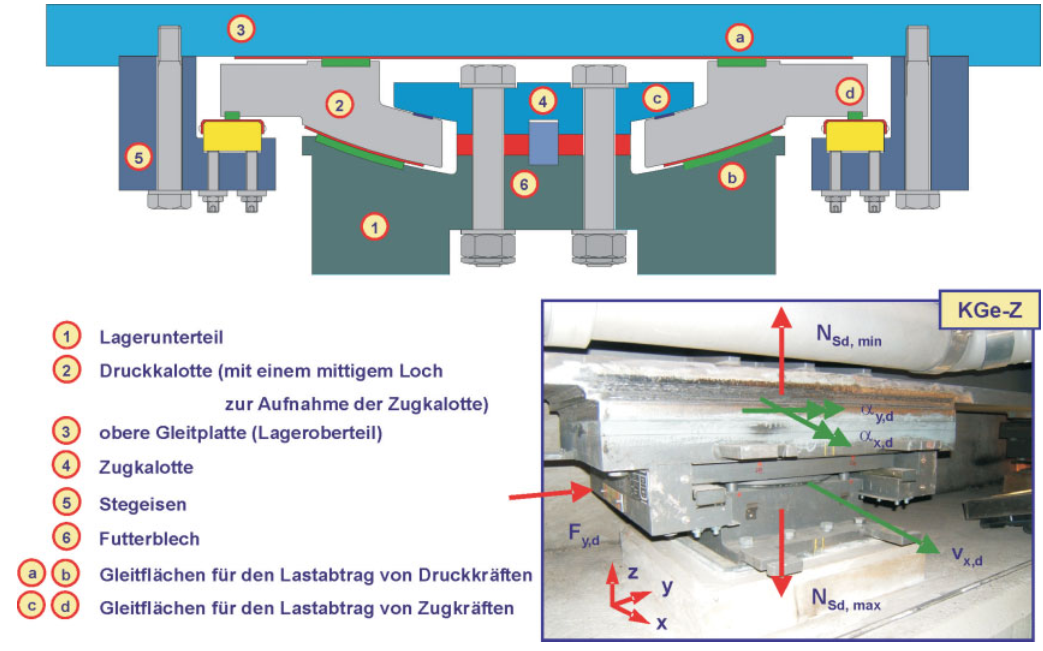
Bearings Under Uplift Loads
Although avoiding uplift forces on bearings is a fundamental principle in bridge engineering, in some cases this cannot be achieved. Since there are no normative provisions for bearings subject to uplift, adapted design and detailing rules must be developed for each application.
Application examples illustrate the specific challenges of bearings subjected to alternating loads. The design models presented help engineers correctly account for these forces during the design process.
Bearing Types
- Elastomeric bearings (plain and reinforced)
- Spherical and cylindrical bearings with PTFE or MSM®
- Roller bearings for large displacements
- Fixed restraints — point and linear