
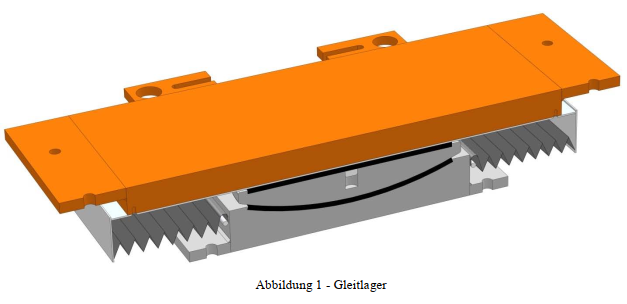
In 2016, Maurer specialists conducted a detailed study on the behaviour of sliding bearings under operational loads in structural applications.
Sliding bearings are key components of modern bridge and industrial structures. They accommodate thermal deformations, seismic displacements and dynamic actions while maintaining the load-bearing capacity of the structure.
Deformation Behaviour
The study focused on analysing the stress-strain state of sliding interfaces under various loading regimes: vertical loads, horizontal forces, and combined actions typical of real service conditions.
Special attention was paid to next-generation sliding materials — PTFE and the high-performance MSM® (Maurer Sliding Material), which exhibits significantly lower friction coefficients and improved durability compared to conventional solutions.
Test Results
Testing showed that MSM® reduces the friction coefficient to as low as 0.5% under high loads, while standard PTFE typically yields 3–5%. This is critically important for calculating the horizontal forces transferred to foundations and load-bearing structures.
The use of high-performance sliding materials significantly reduces loads on the substructure and extends the service life of bearings in operation.
The findings formed the basis for design guidelines and bearing selection recommendations for civil engineering projects, including seismically active regions such as Kazakhstan.