
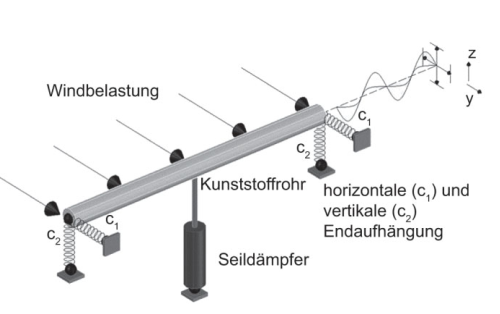
Evaluation of the operating principle of adaptive dampers for cables in bridge engineering through a combination of numerical simulation and full-scale testing.
On many long-span cable-stayed bridges, dampers are installed to reduce vibration in the stay cables. The primary goal is to suppress unwanted out-of-plane lateral oscillations of the main load-bearing cables.
The Problem of Lateral Oscillations
Research shows that reducing in-plane cable displacements in the direction of the dampers also affects out-of-plane displacements. These phenomena were studied in detail as part of a research project at the Department of Concrete Structures at the Technical University of Munich, using hybrid testing techniques.
Adaptive dampers can adjust their damping action in real time depending on the nature and intensity of structural vibrations.
Hybrid Testing Technique
The hybrid method made it possible to combine the advantages of a physical full-scale cable test with numerical simulation of the entire bridge's behaviour. This provided high-accuracy results at significantly lower cost than testing a full-scale structure.
- Numerical model of the cable-stayed bridge accounting for geometric non-linearity
- Physical cable test with a real damper under laboratory conditions
- Real-time online coupling between numerical and physical models
- Adaptive damper control algorithm based on feedback
Conclusions and Application
The study confirmed the effectiveness of adaptive dampers for cable-stayed bridges. The developed control algorithms formed the basis of Maurer's product line for active and semi-active vibration control in cable structures.